
SINDNOVA
Study and research centre on industry innovation and labour
VAT 02153791005
F.C. 97036220586
Address
via Tagliamento 9
00198 Rome (Italy)
Social
SINDNOVA
Study and research centre on industry innovation and labour
P.I. 02153791005
C.F. 97036220586
Address
Via Tagliamento 9 00198 Rome


SindNova is a recognized non-profit association that has been involved in studies, training and information for forty years with the aim of deepening and promoting the culture and tools of worker participation in companies.
Industrial relations, working conditions, European Works Councils, the protection of workers' health and safety and sustainable development are the main areas of competence of the Institute.
On these topics SindNova promotes and organizes in Europe comparison initiatives and high-profile national and international study and training projects.
ALL RIGHTS RESERVED © 2026
Featured
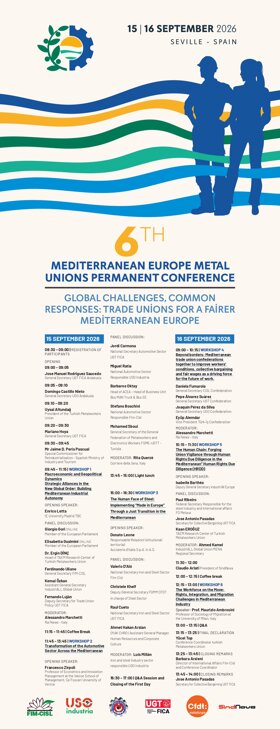
6th MEDITERRANEAN EUROPE METAL UNIONS PERMANENT CONFERENCE
On 15 and 16 September 2026, the major international event titled "Global challenges, shared responses: unions for a fairer Mediterranean Europe" will take place in Seville.
The event will bring together leading union leaders, academics and industry experts to discuss the future of work, industry and workers' rights in the Mediterranean area.
Over the two days, six workshops will alternate, focusing on key dynamics for our sector:
Geopolitics and industry: strategic alliances for the Mediterranean's industrial autonomy.
Automotive sector: the challenges of transformation and the energy transition.
Sustainable steelmaking: implementing the "Made in Europe" model through a just transition.
Rights and bargaining: the role of trade union confederations in improving wages and working conditions.
Human rights: union oversight through human rights due diligence (HRDD).
Migration and work: integration and protection of the workforce on the move.
The event is organised in synergy by Sindnova and FIM CISL.
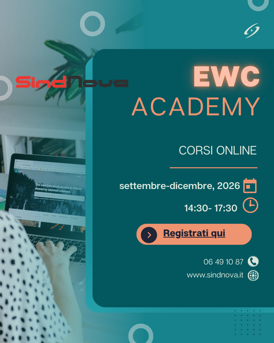
The new challenges of European Works Councils: EWC Academy is born
In a global economy where strategic decisions go beyond national borders, professional upskilling is the key to effective union protection. In light of the revision of Directive 2009/38/EC, we support workers’ representatives in the development of their skills.
Why train today?
- Transnational scenarios: Understand and steer global business dynamics.
- New regulatory framework: Manage with awareness the evolution of the EWC Directive.
- Strategic role: Act effectively in information, consultation and negotiation processes.
Our value: EWC Academy
Our ongoing, high-quality training offer is designed specifically for EWC members and union delegates. We provide you with the tools and skills needed to successfully face the new European challenges.
Publications
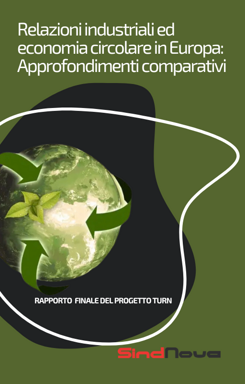
Industrial relations and the circular economy in Europe: comparative insights
The final report of the TURN project provides an important in-depth look at the role of the social partners in managing the ecological transformation of production systems, with particular focus on five strategic sectors: metallurgy, chemicals, textiles, energy and construction. The report examines how industrial relations can be a strategic tool to steer a fairer and more sustainable transformation, highlighting the importance of equipping the actors involved with skills, institutional support and political recognition. In particular, it stresses the potential of European Works Councils (EWC) as transnational platforms for anticipation, consultation and coordination within multinationals. The document also brings together the results of case studies, interviews, surveys and round tables across different countries, offering a rich picture of good practices, challenges and recommendations. The publication is intended as a useful tool for policy makers, worker representatives and stakeholders interested in promoting a sustainable, inclusive and socially fair industrial transformation.
.png "cover_it (copertina libro di wattpad)")
Green Transition and Participation
The publication examines how the European Green Deal is profoundly reshaping the economy, production and work, showing that sustainability is not only an environmental goal, but a field of social debate in which workers must have an active role. The new EU rules – from the CSRD to the taxonomy, from the CBAM to the ETS – require greater transparency and the integration of sustainability into corporate strategies, highlighting the importance of social dialogue able to co-design the transition.
Through advanced examples in Europe, the volume presents a model of anticipatory and “green” trade-union participation, which contributes to sustainable planning and the protection of rights. Central is the role of European Works Councils, to be strengthened both at the regulatory level and through tools and training, as shown by the experiences of the MEET project. The publication thus points to a concrete path for participatory and sustainable governance of the ongoing transformations.
European Works Council (EWC)
The European Works Council (EWC) is a transnational representative body through which employees and their representatives exercise their rights to information, consultation, and participation in multinational companies.
Over the years, SindNova has acquired significant knowledge and expertise in the process of establishing and assisting EWCs. The institute organizes training courses for EWC members aimed at strengthening cross-functional and role-related knowledge, as well as acquiring skills and tools useful for understanding corporate changes. It offers high-level consultancy and periodic training to EWC members from various sectors and multinational groups.
European Project
Project TURN " Industrial relations
towards the circular economy in the metalworking, chemical, textile, energy and construction sectors"
MEET Project "Towards a green and just transition in the metalworking sector: improving the involvement of EWC members in multinational companies"
SHAPE Project "Social partners as architects and creators of the social Europe: discovering its foundations and future"
The social partners have always played a role in the definition and formulation of the laws and policies of the European Union (EU). Yet these roles have changed significantly over time depending on the politics in European capitals and EU institutions, as well as the changing structural challenges faced by European societies.
This project will offer a new understanding of the formation and realization of social Europe by the social partners: building on fundamental foundations to consider possible futures.
Reconstructing the history of the EU to better understand the past and assess whether the fundamental rights and political roles granted to the social partners in the EU are in line with the current social and labor challenges the EU is facing, and to put forward proposals that prepare and adapt the relevant EU acquis to the rapidly evolving nature of the labor market.
In the context of today's work environment, where worker participation and voice are fundamental elements for effective and sustainable business management, the European MEET project aims to create an opportunity for discussion, in-depth analysis, and training on topics of crucial importance for operators and stakeholders in the metalworking sector.
The MEET project intends to export, share, and improve the positive experiences achieved, from the national to the European level, in order to collect best practices from similar initiatives on the topics of sustainable development, circular economy, and energy saving, with the aim of creating a synoptic summary framework that highlights the significant characteristics of the role of the EWC member and worker representatives in relation to these issues.
At the heart of the initiative is the goal of formulating concrete proposals to strengthen the rights of information, consultation, and participation of workers, actively involving actors at various levels, from company level to national and European level.
In an era in which sustainability has become a global priority, the European TURN project aims to explore the action and reaction of the countries involved towards the transition to the circular economy model in the chemical, textile, energy, metalworking, and construction sectors.
The main objective of TURN is clear: to improve and adapt the production systems of these sectors in line with the European action plan for the circular transition. This means abandoning the linear model of "take, make, dispose" and embracing a circular approach that maximizes the value of existing resources, minimizing waste and environmental impact.
Raising workers' awareness that the production system they are part of respects nature and the environment is crucial to ensuring the success of the transition. In addition, providing them with skills and tools to engage in dialogue with the company about this goal is essential to ensure a harmonious and inclusive transition.
Through analysis and research at the community level, as well as in comparative terms, the project will identify convergences and differences in the response of industrial relations systems in the EU, its Member States, and candidate countries. This will make it possible to develop tailored approaches and strategies for each context, ensuring both a local and global footprint at the same time.
The Essential Library
The European Union
File 1
European trade unionism
File 2
The European Works Councils (EWC)
File 3
Transnational company agreements (TCA)
File 4
Confidentiality in European Works Councils
File 7
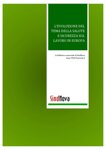
The evolution of the theme of health and safety at work in Europe
File 6
What is it and how to read the financial statements of a multinational company
File 5